Skip to content
September 29, 2026

VICA Proud to Announce 2026/2027 Board of Directors

Vancouver Island’s Construction Industry Well Represented with New Leaders

FOR IMMEDIATE RELEASE

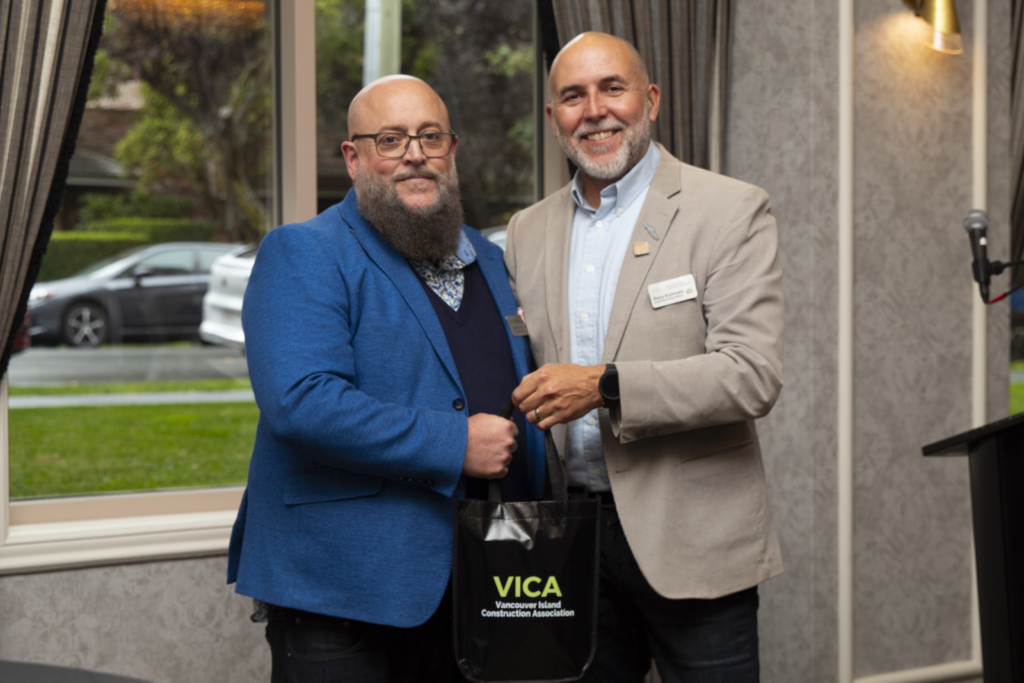
September, 2026 (Victoria, BC) – The Vancouver Island Construction Association (VICA) is pleased to announce several new leaders to its Board of Directors for the 2026/2027 term. The announcement follows the conclusion of VICA’s Annual General Meeting on September 24th, 2026, at the Hotel Grand Pacific where the new board members were officially introduced.
The 2026 election saw strong turnout from eligible members, who participated through online voting software. Each Industry Member is entitled to one vote per election. Participation from voting members shows support for VICA, and, ultimately, the Vancouver Island construction industry.


The 2026/2027 Board of Directors comprises a diverse and experienced group of individuals. The newly appointed members include AJ Winter from Wilson M. Beck Insurance, Max Flynn from Summit Brooke Construction, and Lee Noble from West Isle Industries. Barclay Ellis from Blue Anvil now serves as Past-Chair, Morley Wilkins from Method Chartered Professional Accounting is now serving as Chair, Chris Williams from Houle Electric is the Vice Chair, and Emma Miller from MNP LLP is taking on the role of Treasurer. Byron Tarby remains Secretary.


Additionally, VICA wants to extend gratitude to the past serving directors, Stuart Cuthbert from Slegg Building Materials and Kate Ulmer from Herold Engineering. Their time working on board has provided expertise and insight into guiding VICA’s strategic decisions. We thank them for their attentiveness and ongoing support through their time at VICA.


CEO / CHAIR QUOTES


” Solving difficult problems in the construction industry is what we do, and we’re confident the Board of Directors will guide the association to best serve the interests and concerns of our members. Our new board brings together diverse leadership and fresh perspectives from across the industry as we continue to work through the economic challenges and emerging opportunities here on Vancouver Island.”
~ Rory Kulmala, Chief Executive Officer, Vancouver Island Construction Association


“I’m honoured to take on the role of Chair and excited about what lies ahead for VICA. I look forward to working with our Board, staff, and members to champion our industry and help build a strong future for construction on Vancouver Island and the Sunshine Coast. Our industry continues to face both challenges and exciting growth opportunities. I am looking forward to the strides that the association will make in 2027.”
~ Morley Wilkins, Board Chair, Method Accounting


The VICA Board of Directors plays a crucial role in guiding the association’s strategic direction, providing oversight on key initiatives, and advocating for the construction industry across Vancouver Island and beyond.


MEDIA & INTERVIEW INQUIRIES
Madison McClintick
Marketing & Events Specialist
Vancouver Island Construction Association (VICA)
madisonmcclintick@vicabc.ca | 250-800-1722


ABOUT VICA
The Vancouver Island Construction Association (VICA) serves the construction community on Vancouver Island, the Gulf Islands, and other coastal areas of British Columbia. Our members come from all sectors of the industry, including institutional, commercial, industrial, civil, and multi-family residential construction. With a history dating back to 1912, VICA is one of Canada’s oldest not-for-profit construction associations, dedicated to providing advocacy, professional development, and support to the region’s construction industry.

30 –

August 24, 2026

 Supporting Canadian and Local Businesses 

Every so often, a global event reminds us that the economy is not some distant concept discussed only in boardrooms, financial markets, or government offices. It is something we experience every day through the products we buy, the services we use, and the businesses we choose to support. 

Recent tariff announcements and growing trade uncertainty have once again shone a spotlight on just how interconnected Canada’s economy is with the rest of the world. For the construction industry, this is particularly evident. Materials, equipment, technology, and manufacturing components often cross multiple borders before arriving at a jobsite. Whether we are building homes, schools, hospitals, or infrastructure, our supply chains are global in nature. 

As an industry, we have always demonstrated resilience by supporting one another through changing market conditions. While global trade and supply chains will remain essential to our success, making a conscious effort to buy local and buy Canadian where practical can help strengthen the businesses and communities that support our industry every day. 

The reality is that no contractor, supplier, or business owner can simply switch to purchasing exclusively Canadian products. Nor should they be expected to. Price, quality, availability, specifications, and client requirements will always be critical factors in purchasing decisions. 

But perhaps there is an opportunity hidden within this moment. 

Rather than asking whether we can buy Canadian all the time, perhaps the better question is whether we can buy Canadian more often. 

The construction sector understands better than most the importance of investing in local capacity. Every day, Vancouver Island businesses rely on local contractors, consultants, suppliers, manufacturers, transportation companies, and service providers to keep projects moving. These relationships form the backbone of our regional economy. They are built on trust, reliability, and a shared commitment to the communities in which we live and work. 

This is not about criticizing international companies that do business in Canada. Many are major employers, important taxpayers, and valued members of the communities they serve. However, when Canadian businesses have the opportunity to compete, there is value in recognizing the broader economic impact of choosing them. Canadian-owned companies are more likely to keep decision-making, investment, and profits within Canada, helping to strengthen local businesses, support future growth, and build the economic resilience that communities such as those on Vancouver Island rely upon. Every purchasing decision may seem small in isolation, but collectively those choices help determine where investment flows and where future opportunities are created. 

The economic impact of these decisions is substantial. While a single purchase may seem insignificant, the collective purchasing power of British Columbia’s construction industry is enormous. If more businesses made a conscious effort to source products and services locally when practical, the cumulative effect would strengthen communities throughout the Island and across the province. 

Importantly, this is not a call for protectionism. Canada has long benefited from international trade, and our future prosperity depends on maintaining strong relationships with trading partners around the world. Trade creates opportunities, enhances competition, and allows businesses to access products and technologies that may not be available domestically. 

At the same time, recent years have taught us valuable lessons about resilience. The pandemic, supply chain disruptions, labour shortages, transportation challenges, and now renewed tariff concerns have all demonstrated the value of strong local networks. Businesses with trusted regional suppliers and established community relationships were often better positioned to adapt when disruptions occurred. 

Supporting local businesses is not always about finding the lowest price. It is about recognizing value in a broader sense. Local companies frequently offer faster response times, stronger customer service, greater accountability, and a deeper understanding of regional conditions. They understand the unique challenges of doing business on Vancouver Island and have a vested interest in the success of our communities. 

Fortunately, identifying local and Canadian suppliers has never been easier.  

Resources such as these make it easier to connect with Canadian-owned businesses and products when suitable options exist.  No one expects businesses to abandon established suppliers or disregard sound business practices. This is not about buying Canadian at any cost. Rather, it is about being intentional. When a local or Canadian option exists and can meet the requirements of the job, it deserves consideration. 

The construction industry builds more than structures. It builds communities, economies, and opportunities. Every purchasing decision is, in some small way, a chance to invest in the future we are collectively creating. 

Canadians have become accustomed to checking the news and discovering a new tariff, a revised tariff, a tariff exemption, or a pause on a tariff that was announced only days earlier. Rather than trying to predict the next twist in an increasingly unpredictable story, perhaps our energy is better spent strengthening what we can control. Supporting local and Canadian-owned businesses when practical is not about politics, protectionism, or picking sides. It’s about investing in the communities, workers, and industries that are already investing in us. Whatever comes next, that’s a strategy that should stand the test of time. 

Rory Kulmala 
CEO, Vancouver Island Construction Association 

June 18, 2026

Bringing a new member-member learning Initiative to VICA: Shop Talk

VICA recently launched a new free program exclusively for members called Shop Talk. Manager of Training, Education & Workforce Development, Jenn, created the program to give members the opportunity to showcase current projects, host seminars, and organize site visits that other members can attend.

“This new VICA member-to-member learning initiative aims to connect members through free webinars, site tours, and demonstrations that showcase their companies, projects, or services with the support from VICA” says Jenn.

“A major advantage of Shop Talk is that it is approved for Gold Seal credits, allowing participants to earn one credit for every three hours of the Shop Talk program.” Whether it’s one three-hour session or three one-hour sessions, participants can earn credit, and certificates of completion will be provided.

In an ever-changing economy, it is crucial for construction employers and employees to stay informed and connected within the industry. VICA is a strong advocate for training and educational opportunities that help members advance their careers, such as pursuing a project management role, understanding the importance of ethics, or developing foundational skills in a specific trade like electrical work or crane operation.

Shop Talk gives members the tools to stay educated and connected while developing their pathway in the building industry.

To learn more email Jenn at education@vicabc.ca